GLAPN in public: community programs about LGBTQ history
Links to the program descriptions:
Our Stories: Pioneers in Oregons fight for gay rights, January 12, 2008
Our Stories: A Quarter-Century of AIDS, March, 2008
Our Stories: Coming Out/Making Waves, October, 2008
Our Stories: Out for Good – 40 Years After Stonewall, May 23, 2009
Our Stories: "Finding Our Voice – the 1970s"
Two Spirit Gathering at Portland State University, May 26, 2010
Our Stories: If it's Sunday, this must be Portland, May 22, 2011
Our Stories: Women's Softball, November 5, 2011
Our Stories: Pioneers in Oregons fight for gay rights, January 12, 2008
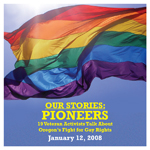 On January 1, 2008, the Oregon Equality Act, a comprehensive set of anti-discrimination laws, went into effect to end discrimination against homosexuals and queer-identified individuals in all facets of Oregon’s governance and society. On January 2, Oregon’s Domestic Partnership Law went into effect to honor and protect the rights of “domestic partnerships,” as a compromise to previous failed efforts to enact gay marriage within the State. It took 35 years of struggle and sacrifice to see this legislation through.
On January 12, 2008, some of the pioneers of Oregon's queer civil rights movement gathered at Portland's Q Center to share their stories.
For more about the program, including a complete cast of characters, click here.
The program was videotaped, and a DVD of the proceedings is available.
 Our Stories: A Quarter-Century of AIDS, March, 2008
Members of the caregiving community and long-time HIV survivors discussed changes in their lives and their community since the discovery of the virus.
Our Stories: Coming Out/Making Waves, October, 2008
Life-changing decisions effect individuals who make them, but may also have ripple effects on entire communities. Such are the stories that were shared October 4 at Portland's Q Center.
 Eight individuals shared their own tales about coming out and making a stand on gay and lesbian rights. Their own lives were altered; but the actions they took with and for the GLBTQ community have made a difference to hundreds of other lives.
Designed to tie in with National Coming Out Month, the Saturday event was co-sponsored by the Gay and Lesbian Archives of the Pacific Northwest (GLAPN), which collects and archives the memories and memorabilia of GLBTQ Oregonians. Speakers came from several sub-groups within the sexual minority community - urban, rural, disabled, racial minorities, parents, and activists.
Speakers included Frank Roa (Umatilla Morrow Alternatives); Betty Nelson (Lesbian Community Project and Metropolitan Community Church); Carla Remy (KBOO radio); Larry Smith (Gay Lesbian and Straight Education Network); Mehera Scheu (Sexual and Minority Youth Resource Center); and Don and Joanne Ross (Parents and Friends of Lesbians and Gays).
Introducing speakers will be Dave Kohl, author of the award-winning history of Portland's GLBTQ community, "A Curious and Peculiar People."
Our Stories: Out for Good – 40 Years After Stonewall, May 23, 2009
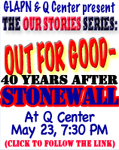 As part of the 40th anniversary of the Stonewall Riots, eight esteemed members of our community shared their stories of how this struggle forever shaped their lives. Come join us for an amazing evening of living history, reconnecting, and hearing shared the stories of Portland’s LGBTQ community.
"No one really expected anything radical from an essentially silent,
secret, secluded subculture which emerged mainly at night, to
congregate in mob bars...So when the spark did come, perhaps it should
not be surprising that it came in of those places, at one of those
times. Perhaps only in retrospect does it seem clear that this was
the logical way it would happen, that the last struggle for civil
rights in the 20th century would begin with a fight at a bar."
-from Dudley Clendinen and Adam Nagourney, "Out for Good: The Struggle to
Build a Gay Rights Movement in America," Simon and Schuster, NY 1999
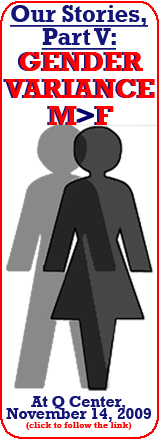
Our Stories: Gender Variance ––>F, November 14, 2009
The Our Stories Series continued on November 14, 2009, with the first of two programs honoring the 30th anniversary of the Northwest Gender Alliance.
The event, sponsored jointly by GLAPN (Gay & Lesbian Archives of the Pacific Northwest) and Q Center, was held at Q Center, 4115 N. Mississippi Avenue, Portland, Oregon, beginning at 7:00PM.
Gender Variance -->F was a panel discussion focusing on the male-to-female portion of our trans/gender-variant community. (A later Our Stories program will feature female-to-male members of the community.)
Five panelists, three trailblazers in Pacific Northwest trans/gender-variant issues and two in the 20s-30s age group, spoke about their personal stories, followed by a moderated question-and-answer period, and open questions from the floor.
Dave Kohl, northwest author, historian and artist, was the MC/Moderator for the evening.
OUR STORIES: "Finding Our Voice – the 1970s"
 On Tuesday evening, October 19, 2010, GLAPN members Rob Douglass, George Nicola and Robin Will appeared on "Out Loud" on KBOO radio to talk about the October 23 event. Here's a link to the program:
http://kboo.fm/node/24437
On Tuesday evening, October 19, 2010, GLAPN members Rob Douglass, George Nicola and Robin Will appeared on "Out Loud" on KBOO radio to talk about the October 23 event. Here's a link to the program:
http://kboo.fm/node/24437
Eight pioneers of the gay rights movement in Portland spoke at Q Center on Saturday October 23 as part of the ongoing series of history forums, “Our Stories”.
These distinguished individuals were active in the early days of the “modern” gay rights movement in the 1970s. They worked to advance our civil rights, establish community, and a positive presence for LGBTQ people in Portland. They created social and community organizations and did the early work that led to the establishment of our legal protections.
Click here or on the "finding our voice" logo to the right to read more about this event.
The program was videotaped, and a DVD of the proceedings is available.
Our Stories: If it's Sunday, this must be Portland, May 22, 2011
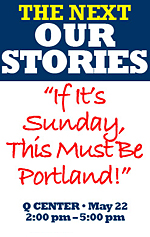 Remember the parties of the 1970s and '80s? Or have you only heard about them? Come to Q-Center Sunday May 22 at 2:30 in the afternoon for a few hours of reminiscing and discovery. This is the 7th in the series of "Our Stories" co-sponsored with the Gay and Lesbian Archives of the Pacific Northwest (GLAPN). Admission is free.
Bars, taverns, and restaurants were the earliest public gathering
places for Portland's "individuals of a different persuasion". Bar owners took the risk of making their establishments "available" to a distinct clientele. A transition from quietly respectable to outrageously "out" accelerated after Stonewall.
"If it's Sunday, this must be Portland" is the theme for May 22,
reflecting the years of long weekends and Sunday brunches that have been a unique trademark of gay Portland "civilization." No one is being asked to
give speeches, but we hope many would come ready to tell us at least one
memorable story. We plan to also have an open question-and-answer session, a chance to just sit back and enjoy memories - old, timely, or recent.
From the early 1970s, Portland gay (and by extension, lesbian, bi- trans, queer) culture revolved around the weekend, usually culminating with a FABULOUS Sunday brunch, the finale to a weekend on-going party. Bar and Tavern owners supported or sponsored events large and small, developing a climate from the fantastic and fabulous to philanthropic and festive (and for a time, yes, even funerial). Portlanders invited their sisters from other west coast cities to the Rose City for a gay weekend - the Court, Ramblers, Chorus, Bears, SportsTeams, Leatherfolk, MCC, and Adventurers. Bar tenders (and even waiters on roller skates) promoted the friendly and provocative, adding yet another layer of "energy" and hospitality to the
party mix, at venues with names like the Embers, Dahl & Penne's, Family Zoo,
Slaughters, Flossie's, Zorba's, Chuckles, Wilde Oscars, Half-Moon, the Harbor, Olde Wives Tales, Demas (later Darcelle's), Hobos, and the Other Side of Midnight.
Our special guests for this informal round-table seminar discussion are some of Portland's esteemed Bar owners and bar tenders. Some were first active in the 1960s – now living treasures of Portland gay history. We want to listen to their tales and innuendos, adventures with customers, police, the OLCC, city hall, boyfriends, dancers, food and drink. And maybe go party after the event....
Our Stories: Women's Softball, November 5, 2011
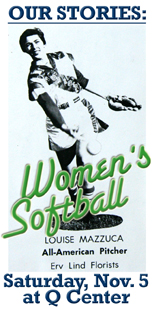 Softball has always had a special place in lesbian culture.
GLAPN and Q Center teamed up to take a look at the earlier days of women's athletics in Portland.
Guests joined us for a night of stories from women who loved the sport as they shared their memories of fast-pitch during the 1960s, the Erv Lind Florists, the impact of Title IX, and the Lesbian Community Project’s annual softball tournaments.
Here’s the line-up:
| Jeanine Wittcke -- opened the evening with a story about how her mother didn’t want her to play “that” sport with “those” women | 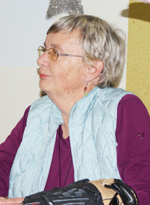 |
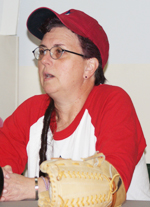
Donna Luckett -- talked about what softball has meant to her. She was involved with the Lesbian Community Project softball tournaments. |
 |
| Louise “Chris” Mazzuca -- one of the best pitchers to ever play the game. She had 9 perfect games and 35 no-hitters. She played for several teams including Erv Lind Florists. | 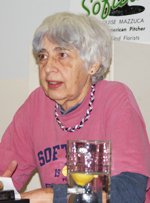 |
| Pat Cach -- became an active follower of fast-pitch softball during the 1960s as she cheered on the Erv Lind Florists women’s softball team. In 1962 she helped drive the team to a tournament in Connecticut. She also helped coach the Lavender Menace 2. | 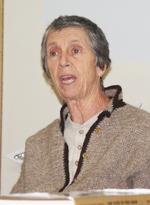 |
| Timi Elwood -- coached girls’ high school sports before and after Title IX. She will talk about what Title IX did for women’s sports. Also, she spoke about the importance of having women in decision-making jobs such as “athletic director.” | 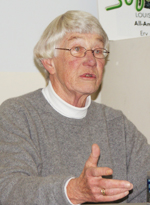 |
| Fern Wilgus — a left-handed pitcher for Dotty Moore Pennant Shop. She played from the early 1960s to 1971. | 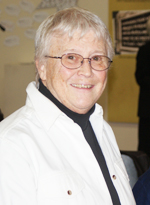 |
 |
 |
 |
 |
20 Years after Measure 9:
GLAPN, Q Center, HRC & BRO celebrate the defeat of Oregon's big anti-gay initiative
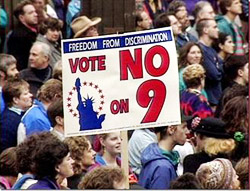 In 1992, in an effort to prevent "special rights" for homosexuals, the Oregon Citizens Alliance's Measure 9 proposed to amend the Oregon Constitution to declare that the state "recognizes homosexuality, pedophilia, sadism and masochism as abnormal, wrong, unnatural, and perverse" and to prohibit spending State funds to "promote" them.
In a bitter and divisive battle, Oregonians defeated Measure 9, 56.5 percent to 43.5 percent at the polls. The struggle was enormously costly to the morale of the LGBT community, where there was never full agreement on how to address the OCA's challenge. Nonetheless, our community and its allies outspent the OCA six to one, and the election was won. It was bittersweet: although we had won, we faced the reality that more than 600,000 people had voted to restrict the rights of LGBT citizens in Oregon; and although we had succeeded in preventing loss of rights, we had gained neither rights nor safety from further initiatives.
Although our community was damaged by the struggle to defeat the OCA, the ground-breaking organizing efforts in 1992 provided the foundation on which Basic Rights Oregon, the Human Rights Campaign, the Rural Organizing Project and Love Makes a Family could carry forward the idea that all people deserve the same equal rights under the law.
On November 3, 2012, four community organizations celebrated the 20th anniversary of the defeat of OCA's Measure 9.
In the morning, Basic Rights Oregon sent out crews to knock on doors in Vancouver, canvassing for freedom to marry in the State of Washington.
During luncheon, and afterwards, speakers reflected on the struggle around Measure 9, and what this victory meant to our various communities. To capture the feeling of the time, there was a showing of a 20 minute film called Fighting for Our Lives, made by local documentary film makers Barbara Bernstein and Elaine Velazquez, to help rural Oregonians understand why they should join the effort to defeat Ballot Measure 9. Following that, two individuals who led the fight against Measure 9 shared insights about that struggle, and the future of queer civil rights. The crowd heard from Kathleen Sadaat, a member of the No on 9 steering committee, who fought to include all voices in the opposition, and Charlie Hinkle, an outspoken attorney who helped organize the legal community to craft the language we needed to talk about the measure.
The gathering concluded with a time for questions and discussion, and a call to action by Basic Rights Oregon.
Here's the text of the E-blast the four sponsors released on Friday, October 26, 2012.
Dear Supporter,
Twenty years after Oregonians defeated an anti-gay ballot measure for the first time, local advocates plan to mark the event with a get-out-the-vote effort for the freedom to marry in Washington and a program that celebrates the importance of this historic event.
Oregon has faced more anti-gay measures than any other state, but in 1992, equality supporters successfully organized and for the first time defeated an anti-gay ballot measure. Measure 9 would have forced schools and the state government to go out of their way to discriminate.
Join us in celebration of this historic victory that galvanized our movement in the northwest:
Nov. 3, 2012 Measure 9 Anniversary The Q Center, 4115 N. Mississippi Ave., Portland, Ore. 97217
9 a.m.: Voter Contact Drive
Noon: luncheon, speeches and documentary viewingHope to see you there!
Barbara McCullough-Jones, Executive Director, Q Center
Chad Griffin, President, Human Rights Campaign
Ismoon Maria Hunter-Morton, President, Gay and Lesbian Archives of the Pacific Northwest
Jeana Frazzini, Executive Director, Basic Rights Oregon
|
|
|
|
Two-Spirit gathering at Portland State University,
Wednesday, May 26, 2010
 GLAPN was honored in the spring of 2010 to be part of the first Two-Spirit Conference in Portland, Oregon. Homo- and trans- phobia are problems in the native community, having replaced the honor that was universally accorded to Two-Spirit people before the coming of the white man. Sponsoring this conference to assist in reviving the Two-Spirit tradition in the native community was a signficant step for the Native American Student Center at Portland State University. Involving GLAPN was generous beyond measure.
"Two-Spirit" refers to a revival of the tolerance and veneration with which Native Americans viewed their gay, lesbian, bi-, transsexual and gender-queer kinfolk in pre-Christian years. The term refers to individuals who have both male and female spirits. "Two-Spirits" also refers to the current movement to erase homophobia in reservation culture.
The gathering was sponsored jointly by PSU's Native American Student and Community Center, and Gay & Lesbian Archives of the Pacific Northwest (GLAPN). It was held at the Native American Student and Community Center on the Portland State University campus (corner of SW Broadway and Jackson Streets).
The featured speakers were Amanda Wright (Klamath), of Portland, OR, who works in the field of public health, and Raven E. Heavy Runner (Blackfeet), who is currently a social worker for Native Children and Families with the State of Washington.
There is no admission charge, and the event will be conducted within safe space ground rules.
INFORMATION ABOUT TWO-SPIRIT HISTORY AND TRADITIONS:
PRINTED MATERIAL:
WEB SITES:Allen, Paula Gunn. The Sacred Hoop: Recovering the Feminine in American Indian Traditions. Boston: Beacon Press. 1992
Blackwood, Evelyn. “Sexuality and Gender in Certain Native American Tribes: The Case of Cross-Gender Females.” Signs: Journal of Women in Culture and Society, 10.1 (1984): 27-42.
Gilley, Brian Joseph. Becoming Two-Spirit: Gay Identity and Social Acceptance in Indian Country. Lincoln: University of Nebraska Press, 2005.
Holzman, Red & Harvey Frommer. Red on Red. New York: Bantam, 1987.
Jacobs, Sue-Ellen, Wesley Thomas (Navajo), and Sabine Lang. Eds. Two-Spirit People: Native American Gender Identity, Sexuality, and Spirituality. Urbana and Chicago: University of Illinois Press, 1997.
Lang, Sabine. Men As Women, Women As Men: Changing Gender in Native American Cultures. Austin: University of Texas Press, 1998.
Roscoe, Will. The Zuni Man-Woman. Albuquerque: University of New Mexico Press, 1991.
Changing Ones: Third and Fourth Genders in Native American North
America. New York: St. Martin’s Press, 1998.Trexler, Richard C. Sex and Conquest: Gendered Violence, Political Order, and the European Conquest of the Americas. Ithaca and New York: Cornell University Press, 1995.
Williams, Walter L. The Spirit In The Flesh: Sexual Diversity in American Indian Culture. Boston, MA: Beacon Press, 1990.
Northwest Two-Spirit Society http://www.nwtwospiritsociety.org/
Native OUT, Phoenix, AZ http://www.nativeout.com
2SPR (Two-Spirit Press Room) http://home.earthlink.net/~lafor002/index.html
Bay Area American Indian Two-Spirits www.baaits.org
Montana Two-Spirit Society www.mttwospirit.org
Nations of the 4 Directions - San Diego www.notfd.blogspot.com
NorthEast Two-Spirit Society www.ne2ss.org
Ohio Valley Two Spirit Society http://ohiovalleytwospiritsociety.blogspot.com/
Two-Spirit Society of Denver www.denvertwospirit.com
2Spirits of Toronto www.2spirits.com
Regina Two-Spirited Society www.allnationshope.ca
[PDF] Microsoft PowerPoint - AHistoryof2SpiritedPeopleFinal[2]
File Format: PDF/Adobe Acrobat - www.2spirits.com/AHistoryof2SpiritedPeople.pdfFirst Nations Two-Spirit Woman self-published book - www.2spirits.com/Two%20Spirit%20Women.pdf
The Impact of Colonization on the Role of the Nontraditional
Native American Woman
http://pages.cs.wisc.edu/~caitlin/papers/native.htm
P.O. Box 3646 • Portland, OR 97208-3646 • info@glapn.or
Copyright © 2015, Gay & Lesbian Archives of the Pacific Northwest